Do participants need horse experience?
No. Joki explains how to be around the horses before the sessions begin.
The half day · Step by step
A half day where every participant has their own session with a horse, while the group learns by witnessing. Systemic inquiry and kinesiology help Joki work with what is actually present rather than following a script.
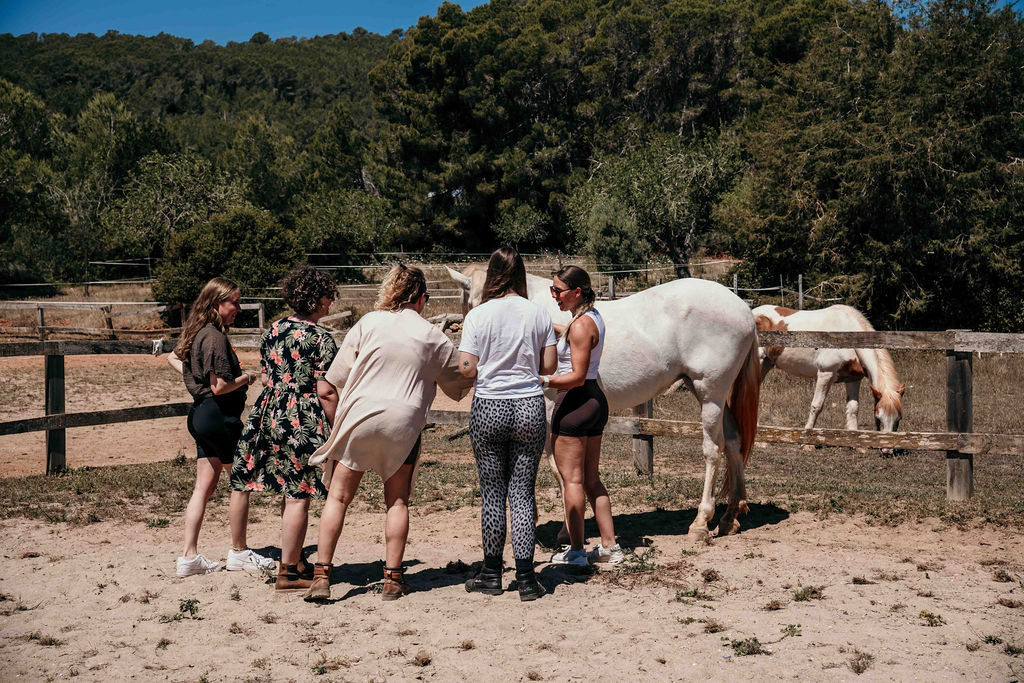
The flow
The pace is unhurried, but the structure is clear. Each stage helps the group understand what they are seeing and how to stay present with one another.
01
Joki welcomes the group, introduces the space and the horses, and explains how to stay safe around them. Everyone remains on the ground. There is no riding and nothing to perform.
02
Before the individual work begins, the group receives a plain-language introduction to place, belonging, hidden loyalties, carrying for others, recurring patterns and the Orders of Love.
03
Each person works with a horse for roughly 15–30 minutes. Joki facilitates through systemic observation and precise questions, using kinesiology when it can help check or refine what emerges.
04
The others stay present and watch. They are part of the field, not an audience waiting for their turn. What they recognise while witnessing can be as relevant as their own time with a horse.
05
There is time to pause, reflect and connect what became visible with the retreat work and daily life. The group leaves with a basic systemic framework, not a prescribed interpretation.
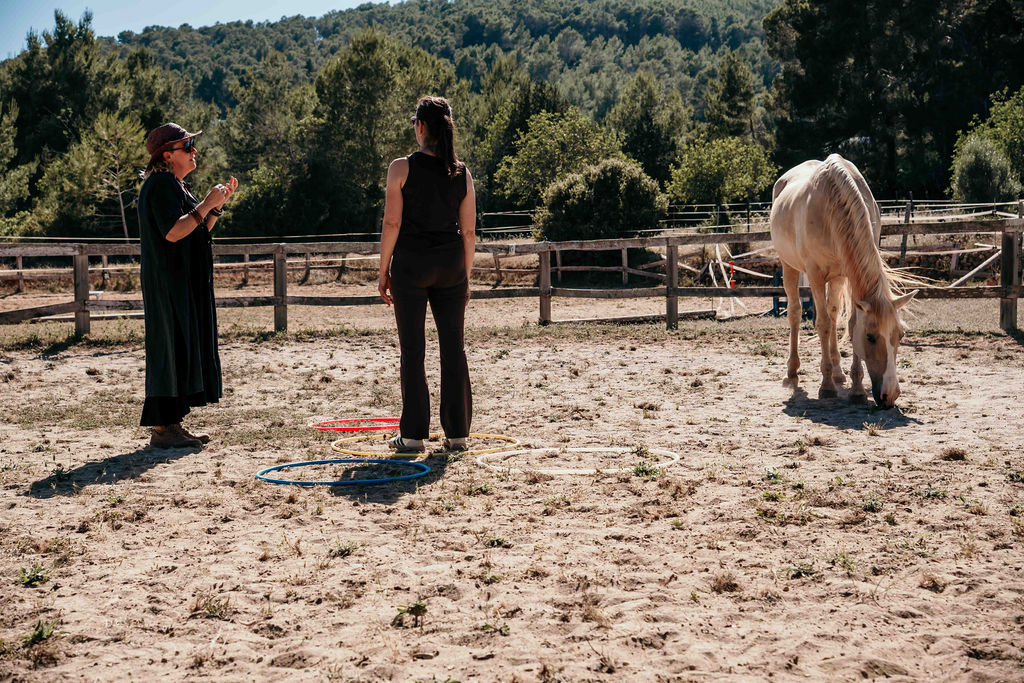
A personal session
Sessions are not scripted. The starting point differs from person to person, and there is no set outcome to produce.
Someone may arrive with a question, a repeating pattern, a relationship issue, a feeling of being stuck, or simply curiosity about what is present. The work begins there.
Joki observes what happens between the participant and the horse, then asks questions through a Family Constellations lens. Sometimes the work concerns place or belonging; sometimes a familiar way of approaching, withdrawing or carrying responsibility becomes easier to see.
Nothing specific is promised in advance. The session follows what can be observed and explored responsibly in that moment.
The group
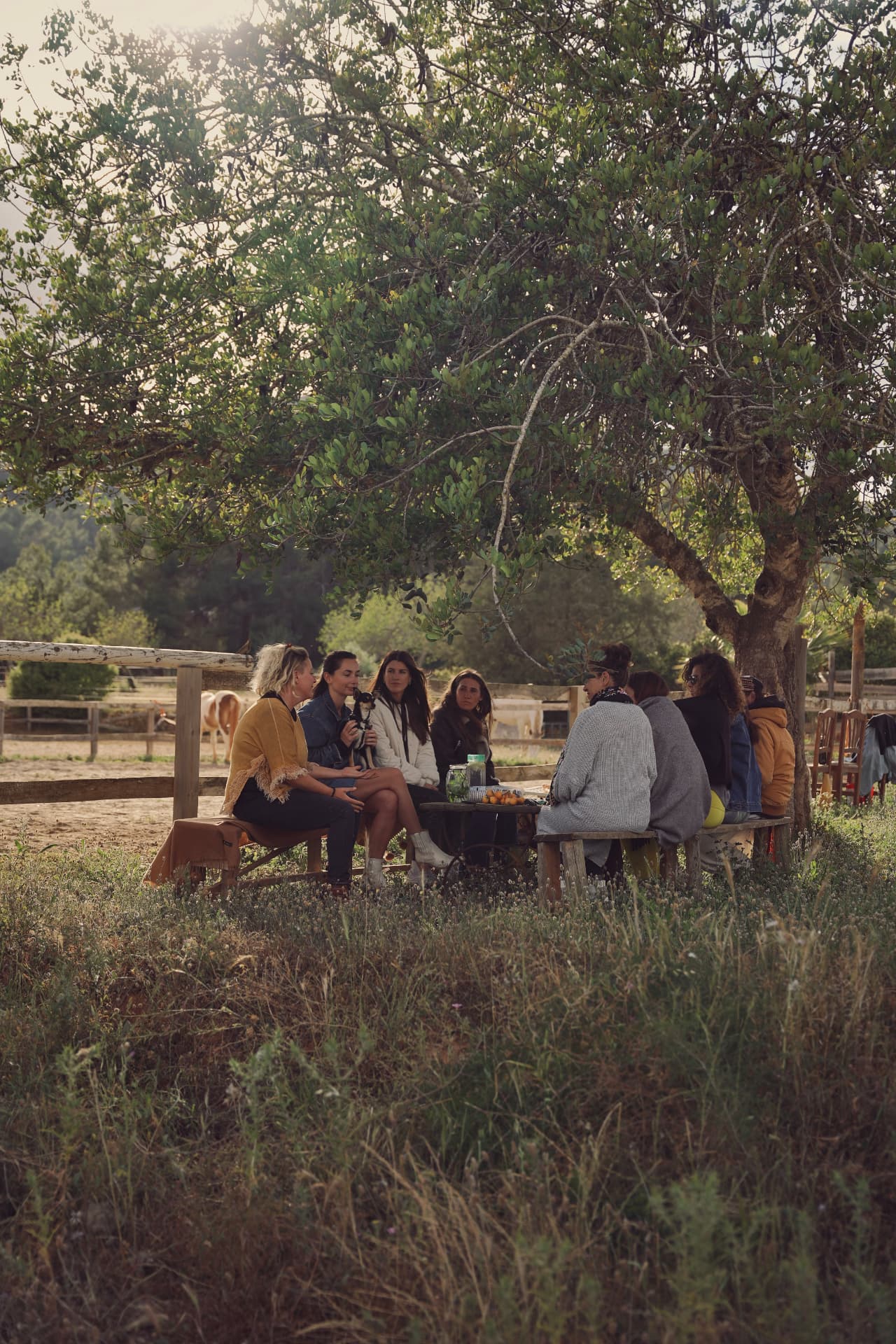
The group remains present while each person works. Under the carob tree, witnessing becomes part of the learning rather than time between turns.
Participants often recognise something of their own while watching another session. They begin to notice how place, belonging, hidden loyalty, carrying for others and repeating patterns may show up in ordinary life.
By the end of the half day, everyone has had a personal experience and learned a basic way of systemic seeing. It is a framework they can continue using after they leave the arena.
The horse
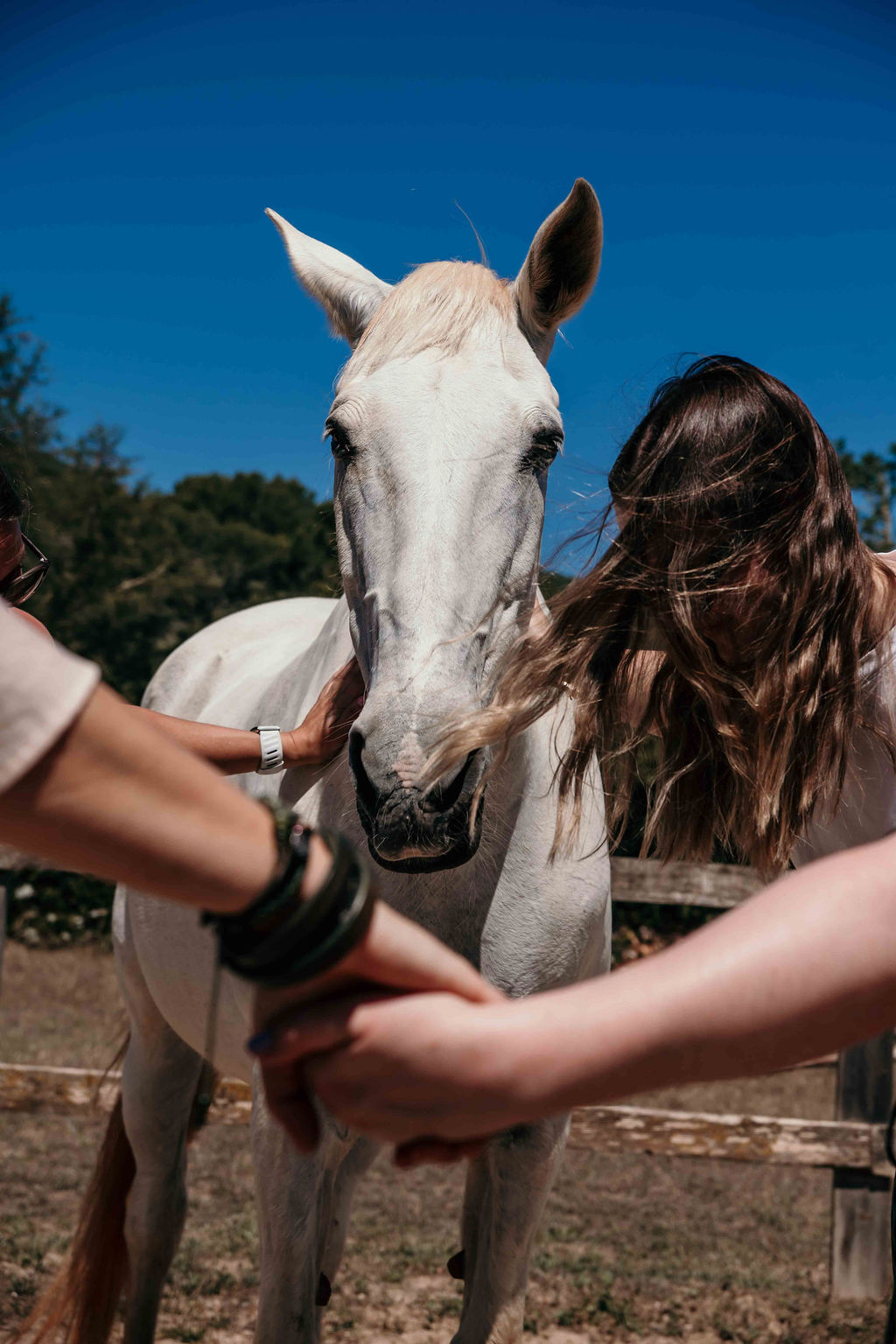
The horse is not there to perform and does not diagnose. It responds to what is happening in the interaction now.
A horse may approach, move away, wait or change its attention. Those responses do not come with a fixed meaning. They give Joki and the participant something real to observe, ask about and explore together.
Kinesiology
Kinesiology is used alongside observation and systemic inquiry. It can help Joki check a direction or refine a question; it is not treated as certainty or as a magical truth machine.
Practical
A focused format for one retreat group, held in Ibiza.
Questions
Practical answers for retreat organisers planning the half day.
No. Joki explains how to be around the horses before the sessions begin.
No. All work takes place on the ground.
Yes. They can participate at their own pace, and nobody is forced into contact with a horse. Distance, observation and choice remain part of the process.
Yes. The retreat leader may take a personal session or remain with the group as a witness.
Please enquire with your group size and dates. Joki can discuss whether a tailored format is possible for that retreat.
Options depend on the forecast, the date and the needs of the group. Please discuss date-specific arrangements with Joki when you enquire.
Dutch, English, Spanish, French and German.
Bring your group
Tell Joki about your group and programme, or request a Facilitator Experience if you want to know the work from inside the arena first.